Cognitive Research:
COgnitive Fatigue in the Digital Classroom
Date: Aug 2020 - Dec 2020
Location: Claremont Graduate University
Role: Research Lead, DIvision of Behavioral & Organizational Sciences
Citation: Kostas, S. C., Dilworth, L., & Moore, D. (2020). Technology Overload? A Phenomenological Examination of Attention and Distraction in the COVID-19 Classroom (thesis).
Research Questions:
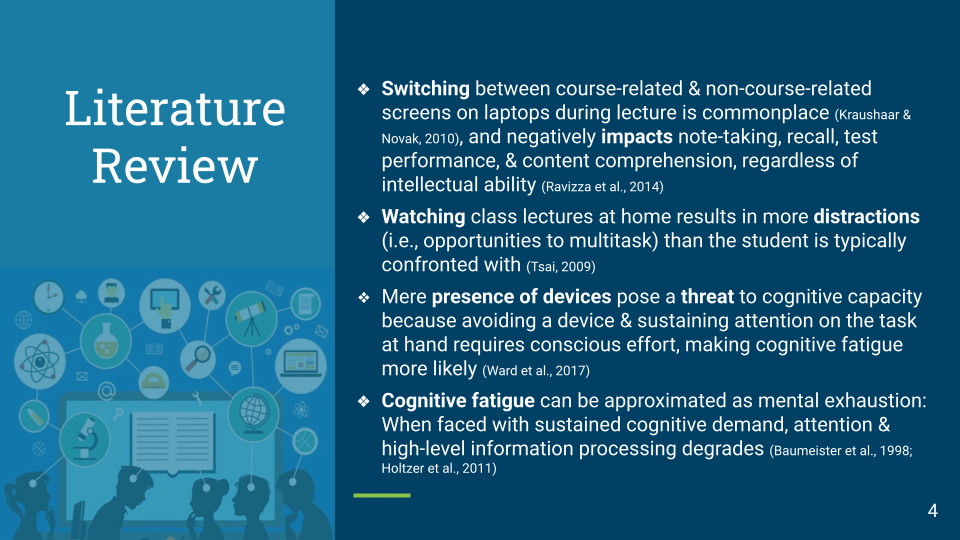
Existing literature on technology overload in education focuses on in-person instruction.
Online learning research is predominantly conducted in laboratory settings and focuses on learning during brief, one-time instruction sessions; unclear how learning varies when online instruction persists for months.
Even if laboratory settings have ecological validity, online learning due to COVID-19 may represent a distinct experience from learning online by one’s own volition, which begs the questions:
With the pervasive use of technology in the current online learning format, how sustainable is high-quality learning?
How, if at all, do cognitive overload, divided attention, & other distractions color ‘COVID-19 students’ online learning experience?
METHODS:
Why Use Qualitative Methods?
Given the unprecedented nature of remote learning during COVID-19, an exploratory inquiry of this experience was fitting as no theoretical framework previously existed. Furthermore, a qualitative approach was taken because it allowed for the desired rich insight into students’ remote learning experience during COVID-19. These students’ individual perspectives were poised to provide meaningful awareness of this unique phenomenon and allow for much needed further in-depth exploration. A phenomenological approach provides rich cognitive representation (Streubert & Carpenter, 1999) and, therefore, was apt for examining students’ online learning experience.
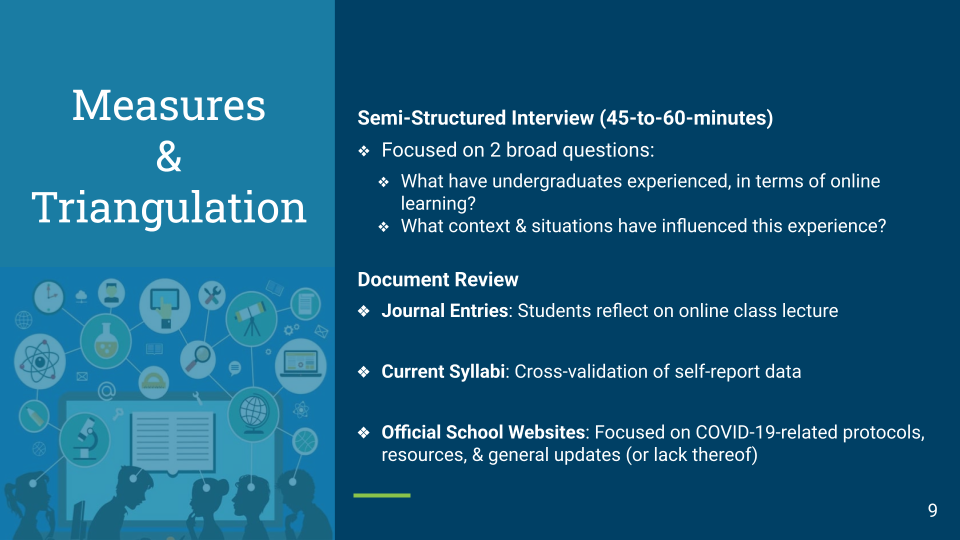
Interviews were conducted in a semi-structured format to ensure flexibility to probe further into topics that seemed particularly pertinent to the students’ online learning experience. Document reviews supplemented this approach, enabling triangulation. This data collection protocol and the subsequent thematic analyses focused on five core areas:
Engagement, Comprehension, & Learning
Digital Devices & Associated Distractions
Emotional, Physical, & Mental States
Distractions in External Environments
Perceived Connectedness
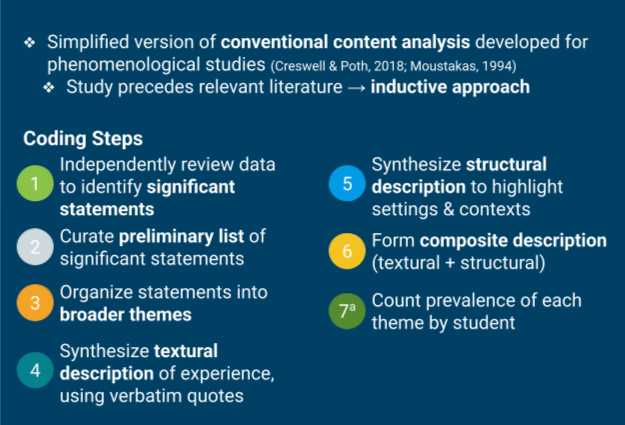
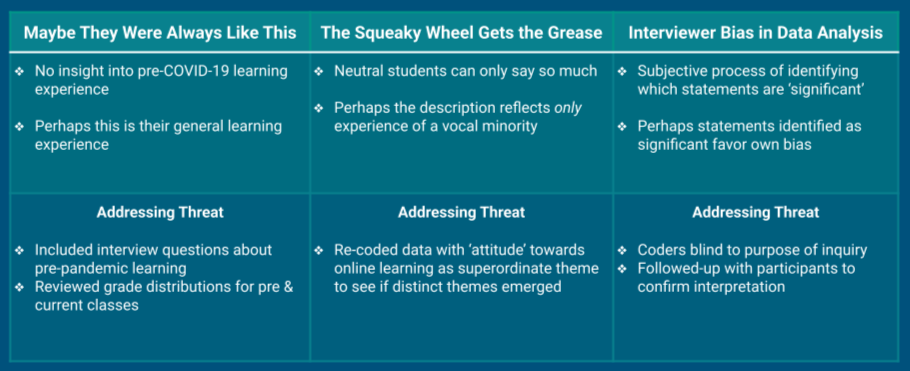
Before proceeding with the investigation, alternative hypothesis were evaluated. Guardrails were implemented, accordingly, to mitigate risk that these competing hypotheses might explain any findings and to enhance the overall validity of the methods:
ResuLTS:
Undergraduate students seem to describe their online learning experience due to COVID-19 in terms of how learning has become easier and how it has become more challenging. Even though students experienced substantial challenges while learning online, online environment has not made learning unmanageable. More common was that classes that might otherwise excite students, now feel lackluster & more effortful:
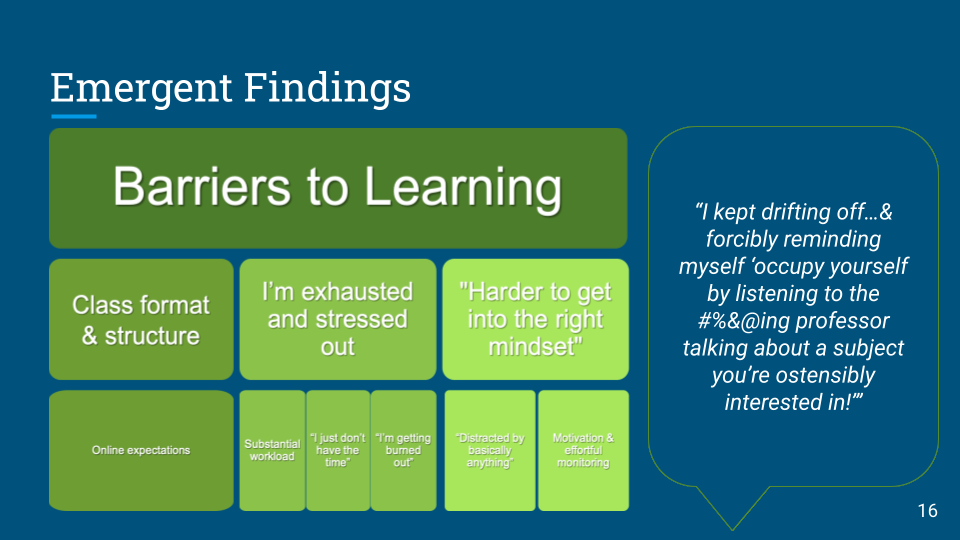
Undergraduates emphasized struggling to absorb class material, feeling exhausted, & trouble focusing, despite conscious attempts to remain attentive– all symptoms of cognitive fatigue.
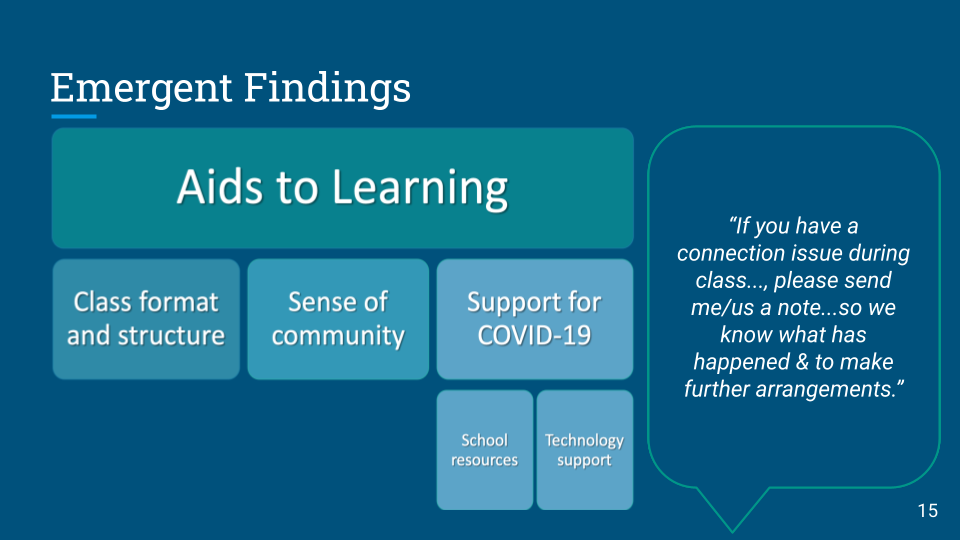
Whether class structure was aid or barrier to learning depends on how compatible structure is with online environment. Other barriers to learning might be minimized by educating professors on effective & ineffective online instruction formats.
Despite document review identifying wide range of resources available to students to support online learning, students were surprisingly silent on the topic🡪 poor/ineffective communication between administration and students.
Future Direction
Restorative strategies to combat cognitive fatigue
What kinds of experiences and opportunities enhance learning in online environments?
Administration-student & professor-student communication
What modes of communication most effectively disseminate information to students?